The Power and Challenge of Difficult Conversations

David Schlosz • January 20, 2026

A MENTORING MOMENTS LIVE RECAP

WITH CALEB MATTHEWS
In this month’s Mentoring Moments Live, I had the privilege of sitting down with therapist, advocate, and community leader Caleb Matthews for a heartfelt and wisdom-filled conversation on “The Importance and the Challenge of Having Difficult Conversations.”


Whether you're a therapist, a counseling student, or someone who values meaningful human connection, this session offered a deep well of insight—practical tools, personal stories, and the kind of truth-telling that encourages growth, empathy, and healing.


Meet Caleb Matthews: Therapist, Advocate, Bridge-Builder.


Based in Austin, Texas, Caleb Matthews brings a unique blend of clinical wisdom and community leadership. As previous Board President of The Human Empathy Project, he helps create dialogue between Christian faith leaders and LGBTQ+ individuals. He’s also the founder of What’s My Therapist Reading?, a free book club for mental health professionals.


Certified in EMDR and trained through a scholarship from the Austin Police Department’s Victim Services, Caleb specializes in trauma therapy and has supported survivors of sexual assault and individuals affected by cancer through his work with the Flatwater Foundation.


What stands out most about Caleb isn’t just his impressive resume—it’s his deep capacity for holding space with compassion and integrity.


On Difficult Conversations: Creating Safety, Space, and Change


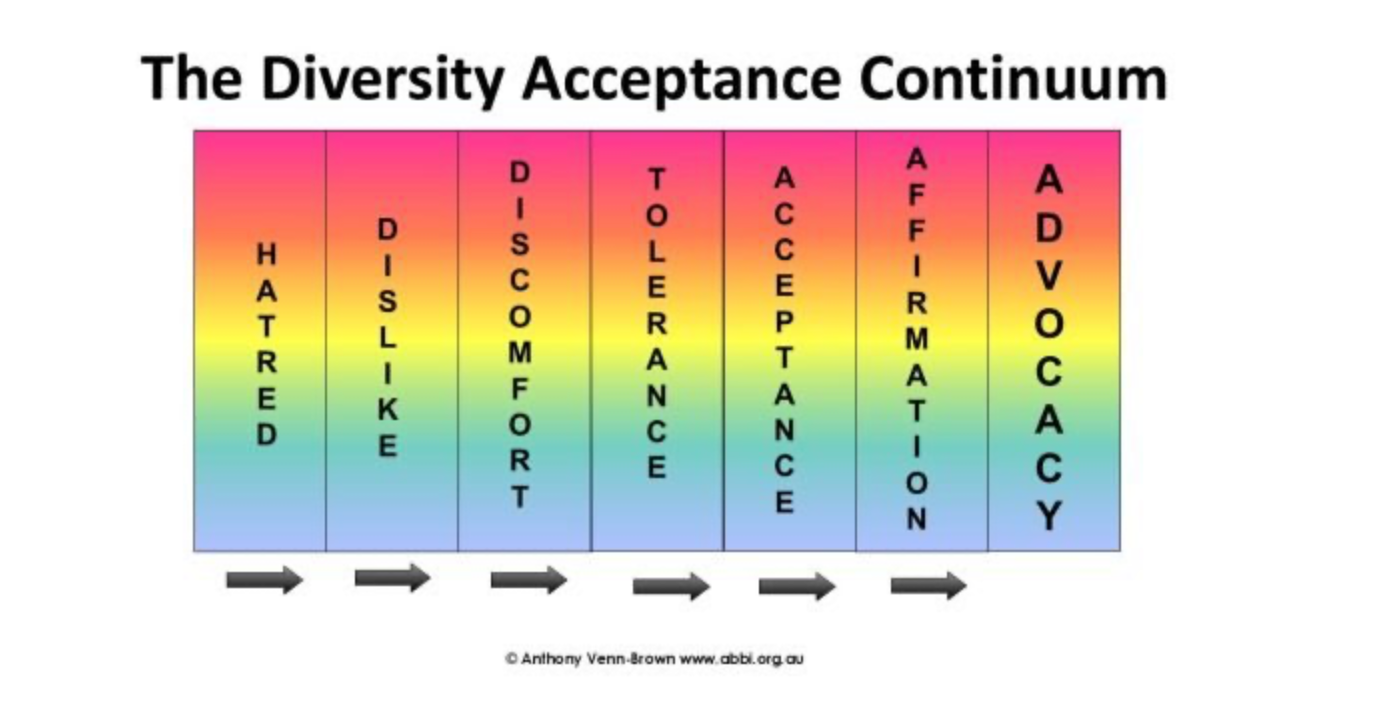
Caleb began by reminding us that hard conversations don’t have to be confrontational—they can be invitational. He introduced the Diversity Acceptance Continuum, a model that maps people's positions on a spectrum from hatred to advocacy. This framework is especially powerful in faith-based settings, where Caleb facilitates dialogue around gender, sexuality, and theology.


Through storytelling and clinical insight, he encouraged therapists and leaders alike to notice and celebrate the small shifts—when someone moves from discomfort to curiosity, or from silence to speaking out. Change, as he reminded us, is rarely instant. It unfolds over time, often in hidden, sacred spaces.


Empathy, Intersectionality, and Holding Difference


Throughout our dialogue, Caleb returned to the theme of empathy as practice. Quoting researcher Jenna St. David, he shared the “law of empathy”—that empathy must flow downhill, from those with more privilege to those with more marginalization. This, he explained, is how we make space for others to be seen and heard without demanding their emotional labor.


Caleb also talked openly about his own intersectionality—his identities around race, gender, sexuality, and body size—and how these realities shape the way he navigates professional and personal relationships.


We discussed the tensions that can exist within communities too. One participant, Brigid, shared a moment between two LGBTQ+ colleagues who had differing views based on their generational experiences. Caleb responded by highlighting the richness—and challenge—of diversity within identity groups. Empathy, he said, must begin with curiosity.


Conversations That Heal: Church, Identity, and “Clean Pain”


One of the more impactful segments was Caleb’s reflection on his work with churches around LGBTQ+ topics. Drawing from Justin Lee’s book Torn, he explained the “Side A” and “Side B” approaches to same-sex attraction and discussed the importance of defining terms early in any conversation.

He emphasized that information alone rarely shifts deeply held beliefs. What truly transforms people is openness of heart—and that requires the safety of nonjudgmental, relational space.


Referencing Resmaa Menakem’s My Grandmother’s Hands, Caleb introduced the idea of “clean pain” versus “dirty pain.”


Clean pain is the discomfort that comes from growth, truth, and healing. Dirty pain is the pain of avoidance, denial, and disconnection. If we want to grow—personally or collectively—we must learn to tolerate clean pain.

Practical Tools and Self-Care

Caleb closed our session by offering concrete strategies for navigating hard conversations:

  • Define terms: Clarity creates safety.
  • Prepare the space: Conversations go better when we feel at ease—walking side by side, riding in a car, or sharing a quiet moment.
  • Model vulnerability: Be the first to go slow, to listen deeply, and to own your limitations.


And finally, for those doing the work of holding space for others, Caleb stressed the importance of self-care: consultation, therapy, genuine friendships, and grace for your own imperfections.


Final Thoughts


This conversation reminded me that the work of empathy is both sacred and gritty. It requires courage, clarity, and the willingness to get uncomfortable. But in that discomfort, there’s hope—a deeper connection with others and with ourselves.


I’m incredibly grateful to Caleb for his vulnerability, brilliance, and leadership. If you missed this Mentoring Moments Live, I encourage you to watch the replay and share it with a friend.


Let’s keep building bridges. One honest conversation at a time.


Resources Mentioned:

  • Torn by Justin Lee
  • My Grandmother’s Hands by Resmaa Menakem
  • Talking Across the Divide by Justin Lee
  • “You Can’t Ask That” – TV series on identity and belonging


Follow Caleb Matthews:

  • The Human Empathy Project
  • What's My Therapist Reading?


By David Schlosz January 20, 2026
My conversation with Josh Rosen is, at its core, about the price of building something big. Not the visible markers; companies launched, revenue milestones, awards, and headlines; but the internal journey that rarely makes it into the highlight reel. We wanted to go underneath the “success story” and talk about what it has demanded of him: the pressure, the identity questions, the loneliness, the impact on mental health, and the way his definition of success has changed over time. The central tension is one many founders live with: how do you pursue ambitious dreams in a way that honors both ambition and humanity? Josh captures his approach in a line he shares right at the beginning: “I need to stand because motion creates emotion.” It’s a simple phrase, but it reveals something essential: his commitment to actively engage his inner world, not just endure it. The Making of a Leader: Duality, Sacrifice, and Audacity Publicly, Josh shows up as a “dream maker”. A leader who runs a digital media company and helps brands with go-to-market strategy. He talks about mentorship with genuine pride, describing himself as a “guiding light” for his team. What matters most to him isn’t a vanity metric; it’s watching people in his company reach real-life milestones: buying homes, building stability, starting families. He calls that his biggest standard of success. But privately, his story has another layer. Under the “unflappable” exterior is a deeply sensitive person who feels the weight of responsibility constantly. While his wife may describe him as someone who “doesn’t get nervous,” Josh tells the truth more plainly: “I’m nervous all the time. I just channel it in a different way.” His drive is rooted in a desire to protect the people closest to him and to do right by those who depend on him. A major theme in our conversation is learning when and how to be vulnerable. Leadership often demands steadiness, especially when you know people’s livelihoods are tied to your decisions. When the pressure spikes, he can’t always afford to fall apart. And still, he’s intentional about letting his team see the human being behind the role—often in moments like off-sites or holiday gatherings where the mask naturally comes down. The Weight of Responsibility and the Loneliness at the Top That gap between external perception and internal experience creates isolation. Josh doesn’t describe himself as an optimist. He calls himself a “measured realist,” and that realism comes with a particular kind of emotional load: the persistent awareness of what could go wrong. Over time, the self-doubt doesn’t disappear, it evolves. In some ways, it intensifies. He reflects on how different it felt in the early years, when the team was small and the consequences were simpler. Now, after 14 years and a staff of about 45, many of whom have been with him eight to ten years, the stakes feel enormous. “It can’t blow up. It can’t go away,” he says. “There’s too much riding on it.” That pressure shows up in the quiet moments, what he calls the “shower thoughts”, the relentless private questioning: Am I the right person to lead this? Am I making the right decision? And while people might see the glamour, travel to San Francisco, New York, Europe, they rarely see what it costs. Josh shares a painful example: the first year of his third child’s life, when she mostly knew him through FaceTime. Missed bedtimes. Missed bath time. The moments you can’t put back. That’s where the deeper existential questions emerge: What’s the point? Am I doing the right thing? Josh believes the “founder spirit” is often defined by the ability to compartmentalize, to hold grief and purpose at the same time, and to let sacrifice become fuel for something bigger. Ultimately, what he’s chasing isn’t just money. It’s freedom, especially the kind that buys time. The dream isn’t the number in the bank account; it’s being present on a random Wednesday at 4 p.m. for a ballet recital. The Reluctant Entrepreneur: Formative Moments and Rejection One of the more surprising parts of Josh’s story is that he doesn’t frame himself as someone who always wanted to be an entrepreneur. He calls himself a “reluctant entrepreneur”, pushed toward building his own path through rejection and disillusionment. He talks openly about not being a great student and struggling to respect teachers who hadn’t “been there.” Growing up in the ‘90s, he felt disconnected from traditional career narratives and more drawn to creativity and connection. A high school teacher, someone with real-world experience at Ogilvy, saw potential in him and opened a door into advertising. Then, at 19, his world cracked open. His parents divorced. His father experienced a serious mental health breakdown. His mother, who had been a career housewife, struggled financially. Josh describes the desperation of those years, including forging a document to receive a college bursary, just to cover food and gas. When that check arrived, around $600 or $800, it became a turning point. He felt a conviction settle into his bones: I will never rely on anyone again. I will be responsible for my own destiny. That resolve made him focused, but also impatient. He didn’t want to “pay his dues.” He felt corporate culture was skilled at “whack-a-moling” ambitious young talent. Every rejection became a stored source of motivation. The final push into entrepreneurship came when the company he worked for was sold to private equity. He was repeatedly asked to lay people off members of his own team. With a young family, the emotional cost wrecked him. Taking away someone’s paycheck wasn’t just “business.” It felt personal. It broke something in him and clarified what he didn’t want to be part of. When the opportunity to co-found his first company appeared, it led to a pivotal conversation with his wife: “If we don’t do it now, when are we going to do it?” Josh credits her support as foundational. She could see that, for him, this wasn’t just ambition. It was purpose. It was happiness. It was the future they wanted. Grounding and the Blur of Identity Josh names something many founders feel but rarely say out loud: the way identity fuses with the business. “I am the business, the business is me,” he says. And when you haven’t taken a true vacation in 14 years without work tagging along, it’s easy to start asking dangerous questions in low moments: Am I only what my net worth says I am? Is that all I am? What counterbalances that, for him, is family. Home life has a way of stripping the illusion off success. No matter what happens professionally, the garbage still needs to go out. Someone still has to get to hockey practice. In that space, you’re not “founder” or “CEO.” You’re Dad. You’re husband. That grounding is part of what helps him keep going without losing himself. Managing Stress and Seeking Support Josh is candid about what stress has looked like in his body and behavior: vaping addiction that escalated during COVID, poor diet, sleep deprivation, irritability. He’s developed a framework rooted in a simple truth: two things can be true at the same time . You can be overwhelmed and still grateful. You can feel crushed and still recognize your privilege. His strategy is to build tools that help him move through emotion faster: to compartmentalize, analyze, embrace, and then release. He speaks highly of therapy, crediting a long-term therapist with giving him practical tools for processing his internal world. He and his wife also do couples counseling, which he describes as a “tune-up”, maintenance, not emergency. One of his biggest takeaways: learning to ask for what you need has been a major unlock. And he returns again to the body: movement as release. The gym, for him, isn’t just about fitness, it’s about clarity. Solutions come in post-workout stillness. Reframing and Resilience A core element of Josh’s philosophy is reframing. He shares a story about his 12-year-old daughter struggling to make friends after a move. He helped her name the “worst case scenario” and then softened it: if today goes badly, she comes home to a family who loves her, eats ice cream, and tries again tomorrow. That shift didn’t erase the fear, but it made her brave enough to act anyway. That same resilience shows up in one of his most defining entrepreneurial memories: a time when the company was close to collapse, there was no money for rent, and he felt depleted in every direction. When his partner asked what they were going to do, Josh answered with a kind of stubborn, grounded courage: we’re going to get up, go to the office, and do the best we can, because that’s what we have left. The next morning, a check from their biggest client was waiting. That moment cemented a belief that has carried him: sometimes the win is simply putting one foot in front of the other. Lessons for Others and a Legacy of Humility Josh’s leadership ethos is surprisingly simple: build the kind of company the younger version of you would want to work for. He emphasizes that people don’t really work for companies, they work for people. And when new hires join, he tells them: “You don’t work for me. I work for you.” When I asked what he would say to a founder quietly burning out, his message was direct: you’re not alone. He urges founders to reach out, to tell the truth, to be vulnerable. He also warns against the glossy mythology of success online. For every Rolex and Lamborghini, there’s often a hidden stack of unpaid credit cards. His advice: live quietly. Let your actions speak. The legacy he wants most isn’t status, it’s humility. He wants his children to understand that nothing meaningful happens overnight. He uses examples like Olivia Rodrigo’s “overnight success” to reinforce the truth: what looks sudden is usually built on years of effort. Josh’s mantra is “Fortune favors the brave.” But in his telling, fortune isn’t primarily money. It’s the life he’s created, the family, the freedom, the ability to be present. In the end, he defines wealth in human terms: the family he’s built and the life they get to live.
By David Schlosz May 20, 2025
An Interview with Whitney Sutherland, LPC.
By David Schlosz April 1, 2025
Counselor Success and Support Initiative
By David Schlosz March 30, 2025
Dr. Charles Heaton on Identity, Inclusion, and the Power of Vulnerability
By David Schlosz March 28, 2025
An Intimate Conversation with Dr. Rachelle Smith on Black Womanhood, Leadership, and Inclusive Transformation in Academia
By David Schlosz March 14, 2025
A Conversation with Pastor April on the Evolving Needs of Christians
By David Schlosz March 9, 2025
HOW WE HAVE LIMITED THE DIVINE
By David Schlosz February 26, 2025
Embracing the Present, Finding Purpose, and Growing Daily
By David Schlosz February 22, 2025
A Conversation with Counselor and Researcher Whitney White
By David Schlosz February 3, 2025
How a Few Words Can Change a Life